The word engineering is showing up in some interesting places lately.
You might encounter context engineering while learning to build with AI, privacy engineering while searching for your next job, or forward-deployed engineering while reading about how technology companies deliver their products.
Then there's GRC engineering, security engineering, cloud engineering, platform engineering, and a growing collection of specialties that sometimes sound remarkably similar.
What do these titles mean to someone working in governance, risk, and compliance? And how much should you worry about understanding all of them?
Probably less than you think.
The Atlanta chapter of the GRC Engineering Club recently participated in the Atlanta Developers' Conference (ATL DevCon). In our conference reflection, we explored how AI-assisted builders can learn from experienced software developers, especially when it comes to architecture, testing, security, and the software development lifecycle.
One of the most encouraging lessons was that you don't have to arrive knowing everything to participate in the developer community.
That lesson applies to the engineering job market, too.
AI-assisted coding is making it easier for people with domain expertise to build useful software. At the same time, engineering practices are spreading into more specialties, and employers are experimenting with how to describe the work.
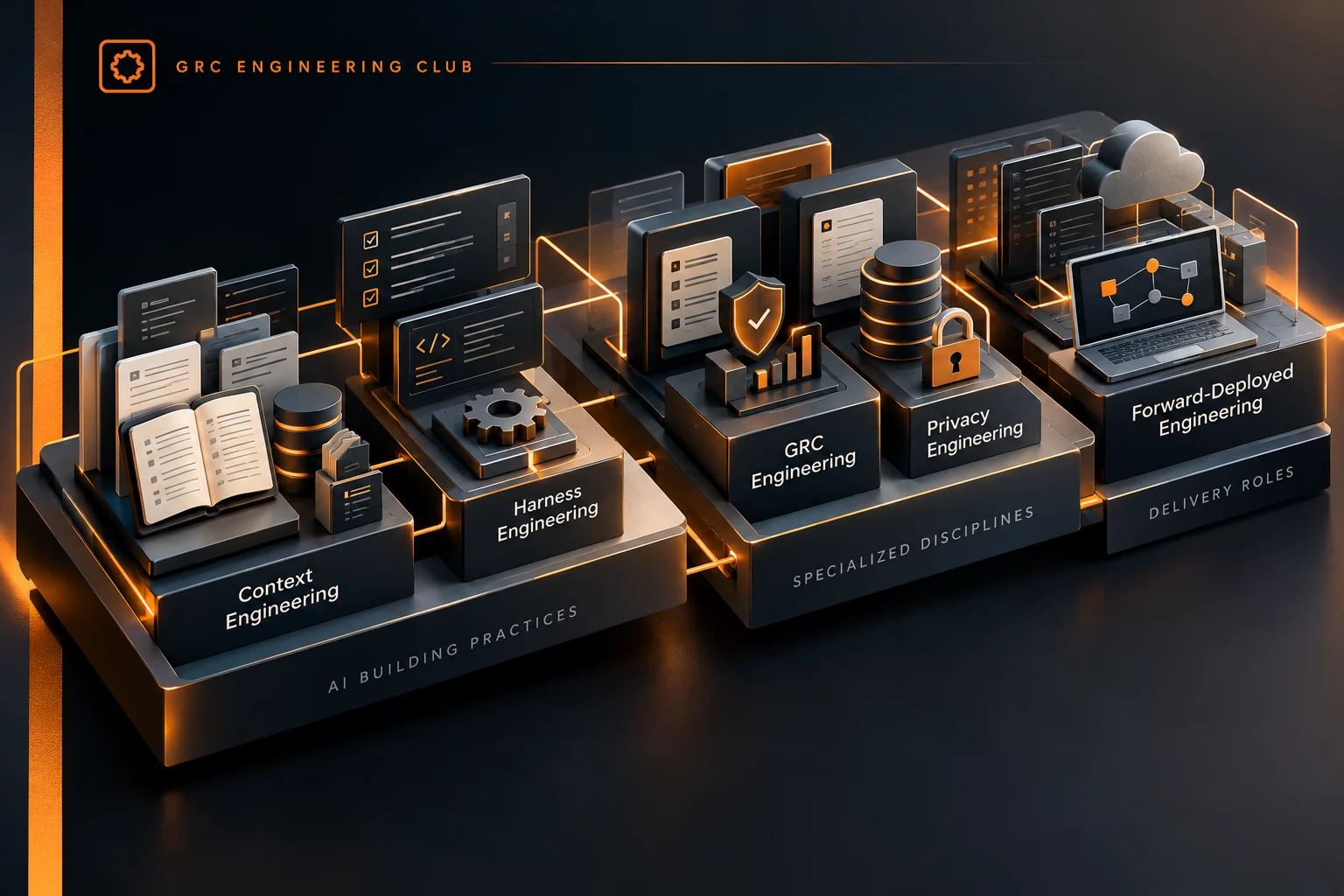
Here are five terms worth understanding, and why the work behind them matters more than memorizing the definitions.
1. Context Engineering
If you've experimented with AI coding tools, you've probably discovered that a good prompt can get you surprisingly far.
You've probably also discovered that your AI assistant can forget an important decision, misunderstand your project, or confidently suggest something you've already tried.
Context engineering is about improving the information available to an AI system when it performs a task.
That might include project instructions, documentation, examples, previous decisions, relevant files, or information retrieved from other systems.
Imagine you're building a compliance evidence tracker. Instead of explaining your requirements from scratch in every conversation, you maintain a project knowledge base that describes the application's purpose, data model, coding conventions, and important decisions.
Now your AI assistant has a better foundation for its work.
We explored this idea in Your AI Projects Need a Knowledge Base.
Context engineering is becoming an important practice in AI development, but don't assume every organization using the term is hiring someone with the title Context Engineer. Sometimes it's simply part of how developers, architects, and AI practitioners do their existing jobs.
2. Harness Engineering
Context helps an AI assistant understand the work. A harness helps establish how that work gets done and checked.
In AI-assisted software development, a harness can include the tools, instructions, workflows, tests, permissions, and feedback mechanisms surrounding an AI coding agent.
Think of the difference between asking an assistant to build an application and giving it a working environment where it can inspect the repository, run tests, identify failures, and report what changed.
For our evidence tracker, a useful harness might check that required fields cannot be skipped, that users cannot access another organization's records, and that changes don't break existing functionality.
The AI may write much of the code, but someone still needs to decide what acceptable behavior looks like.
This connects directly to another lesson from ATL DevCon: generating software is getting easier, but validating it remains essential.
Harness engineering is also an evolving term. It describes a growing area of practice rather than one universally defined profession.
For GRC practitioners, the interesting part is how familiar the underlying questions should feel.
What are the requirements? What controls are in place? What evidence demonstrates that the system behaves as intended? What happens when something fails?
Those questions belong in software development just as much as they belong in an audit.
3. GRC Engineering
Traditional GRC work often involves policies, assessments, spreadsheets, evidence requests, risk registers, and conversations with people across an organization.
GRC engineering asks how we can make those processes work more reliably through systems, automation, integrations, and better design.
Instead of emailing system owners every quarter for screenshots, for example, a GRC engineer might build or configure an integration that collects evidence automatically, checks whether it meets defined requirements, and identifies exceptions for review.
The work could involve APIs, scripts, workflow automation, data modeling, or full software applications.
But it also requires understanding the GRC problem being solved.
Automating a broken process doesn't automatically make it a good process. Someone needs to understand the requirements, the risks, and what the evidence actually proves.
That combination of technical skills and domain knowledge is what makes GRC engineering interesting.
Employers may use the title differently. Some expect software development experience. Others emphasize compliance automation, security tooling, control design, or systems integration.
Read the responsibilities before deciding whether a role fits your experience.
4. Privacy Engineering
Privacy engineering applies technical design and engineering practices to the protection and appropriate use of personal information.
A privacy engineer might help design how a system collects data, enforces retention requirements, manages consent, limits access, or responds to deletion requests.
Consider an organization that promises to delete certain personal information after a defined retention period.
A written policy is important, but the organization also needs to know where the data lives, what systems copy it, which exceptions apply, and whether deletion actually occurs.
Engineering turns that requirement into working system behavior.
This is another area where GRC professionals may already have useful expertise. Understanding regulatory obligations, privacy risks, data governance, and control requirements can provide a foundation for more technical work.
The role itself can still require substantial software, data, or systems engineering skills, depending on the employer.
5. Forward-Deployed Engineering
Forward-deployed engineering is a little different from the previous examples.
Rather than describing a particular compliance or technical specialty, it generally describes engineers who work closely with customers to implement, adapt, integrate, or develop technology for real operational problems.
Imagine a software company offering an AI platform to a financial institution.
The customer has existing applications, data systems, security requirements, and workflows. A forward-deployed engineer may work directly with the customer to connect those systems, develop necessary functionality, and help make the solution useful in practice.
You may notice similarities to solutions engineering, implementation engineering, consulting, or customer-facing technical roles.
That's because there can be considerable overlap.
Some forward-deployed roles involve deep software development and production engineering. Others combine integration work, technical discovery, and customer collaboration. The exact responsibilities depend on the company.
For GRC practitioners interested in building technology that solves operational problems, it's another category worth watching.
Five Terms, but Not Five Equivalent Job Titles
Here's where the vocabulary gets tricky.
Context engineering and harness engineering primarily describe approaches to developing AI systems. GRC engineering and privacy engineering describe specialized disciplines that may also appear as job titles. Forward-deployed engineering usually describes a role and delivery model.
They're not five competing career paths.
And the overlap doesn't stop there.
A cloud engineer might build and operate infrastructure. A cloud security engineer might focus on protecting that infrastructure. A security engineer could spend their time writing detection logic, building security products, automating controls, or working on application security.
A GRC engineer might write production code at one company and primarily configure compliance platforms at another.
The industry hasn't settled on perfectly consistent definitions for these roles, and it may never do so.
That can make job searching frustrating, especially when you're trying to decide which skills to develop.
But there's a more productive way to approach it.
When reading a job description, look past the title. What problems would you solve? What systems would you work with? What would you build, maintain, automate, or improve? How much programming is required? Who would use the results?
Those answers tell you more than the title alone.
GRC, Privacy, and Security Engineering: Where They Overlap
For job seekers, three titles are particularly easy to confuse: GRC engineer, privacy engineer, and security engineer.
GRC engineers commonly focus on making risk, control, compliance, and assurance processes work through technology. They might automate evidence collection, connect compliance systems, or develop ways to test controls.
Privacy engineers focus on translating privacy requirements into technical behavior. Their work can include data minimization, consent, retention, deletion, and the handling of personal information.
Security engineers focus on protecting applications, systems, and infrastructure. Their work may involve access controls, vulnerability management, detection, secure development, or defensive automation.
These aren't rigid boundaries. An automated access-review tool, for example, could support compliance evidence, privacy requirements, and security controls at the same time.
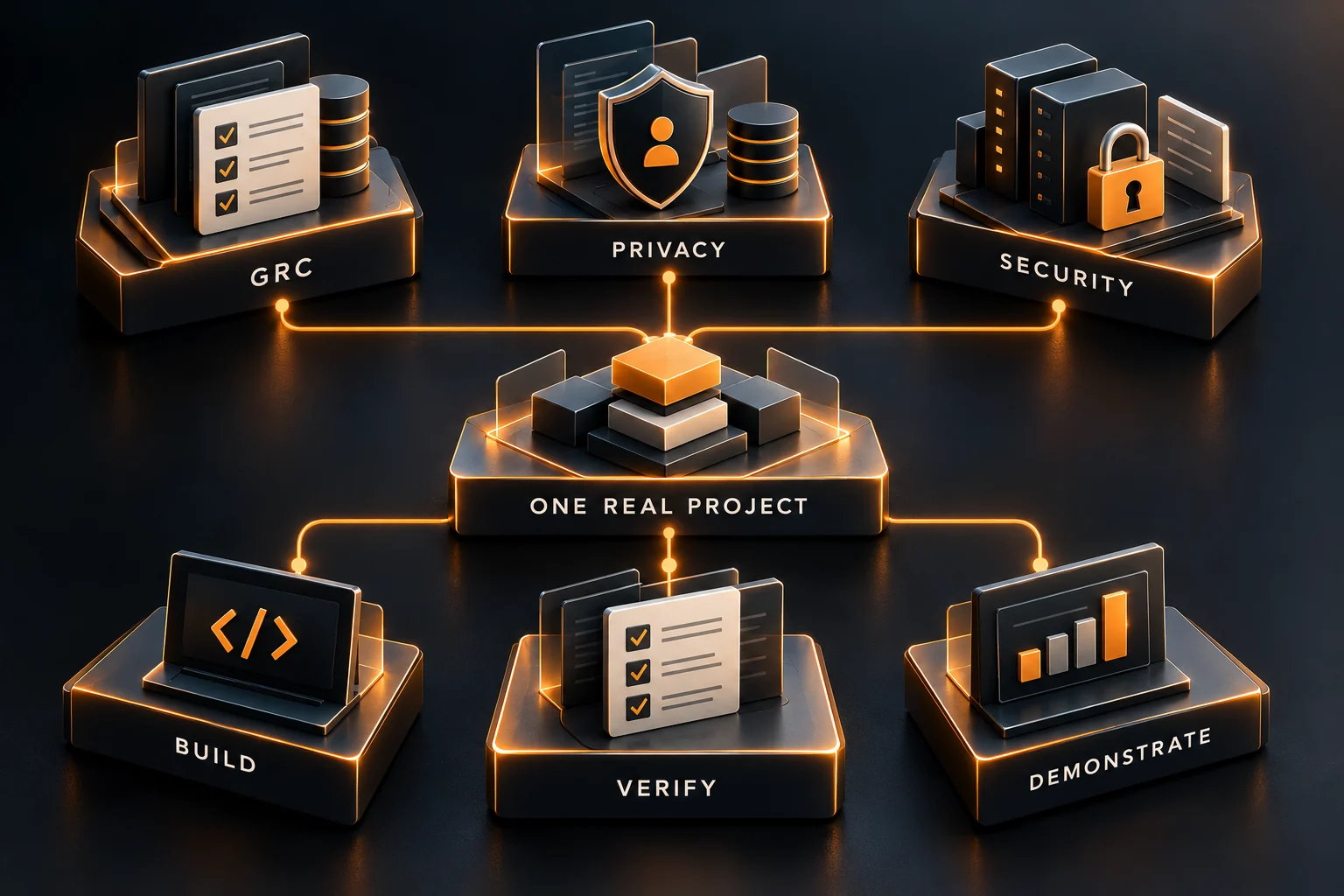
The better question isn't which title sounds most appealing. It's which problems you want to solve, what skills employers actually request, and what work you can demonstrate.
AI-Assisted Coding Changes the Starting Point
Not long ago, someone with a great idea for a compliance tool might have needed to recruit a developer, learn to program, or wait for an existing vendor to solve the problem.
Those options still exist, but they're no longer the only ways to get started.
AI-assisted coding tools can help practitioners create prototypes, connect services, build interfaces, and experiment with workflows without first mastering every programming language involved.
That doesn't make engineering expertise obsolete.
It means more people can begin developing that expertise by working on real problems.
A privacy professional can prototype a data retention dashboard. An auditor can experiment with evidence validation. A risk analyst can build a small application that turns assessment responses into structured findings.
As projects become more ambitious, builders encounter architecture, testing, security, infrastructure, version control, and maintenance.
That's where the learning gets interesting.
Our chapter created the GRC Vibe Coder's Playbook to help practitioners work through that progression. The Vibe Coding Recipe Book helps builders understand different combinations of tools and technologies they can use to create applications.
Neither resource promises to turn someone into an experienced software engineer overnight.
They offer a place to start building and learning.
“Build First. Let the Job Titles Catch Up.”
Build First. Let the Job Titles Catch Up.
The next time you encounter an unfamiliar engineering title, learn what it means. Explore the skills behind it. Look at a few job descriptions.
Then get back to building.
Choose a problem you understand. Create something useful, even if the first version is small. Learn enough about the underlying technology to make informed decisions. Test your work. Document what failed and what you improved.
And make it possible for someone else to see what you've accomplished.
A working project gives you more than a portfolio entry. It gives you a story about a problem, the choices you made, the tools you learned, and the results you achieved.
That's valuable whether the next opportunity calls itself GRC engineering, privacy engineering, security automation, or something we haven't named yet.
The titles will keep changing. Your ability to solve problems, learn new tools, and explain your work can grow with you.
If you need encouragement to begin, revisit Building Is the Skill That Raises All Ships.
Then pick a problem and start building.