The GRC Vibe Coder's Playbook · Lesson 08 of 10
How do I manage AI usage and costs?
Spend AI time and tokens where they add the most value.
All 10 lessons · Jump to a lesson
Metering means choosing tools and monitoring consumption across tasks. Token-maxing means stretching a limited allowance through clear prompts, short feedback loops, and fewer unnecessary regenerations. Plan a change with a general assistant, send a bounded implementation request to a coding agent, and use an independent review when useful.
Track real plan limits and costs rather than assuming that more subscriptions produce better results. For GRC, also consider approved data handling, vendor risk, audit logs, and whether a cheaper workflow compromises review quality.
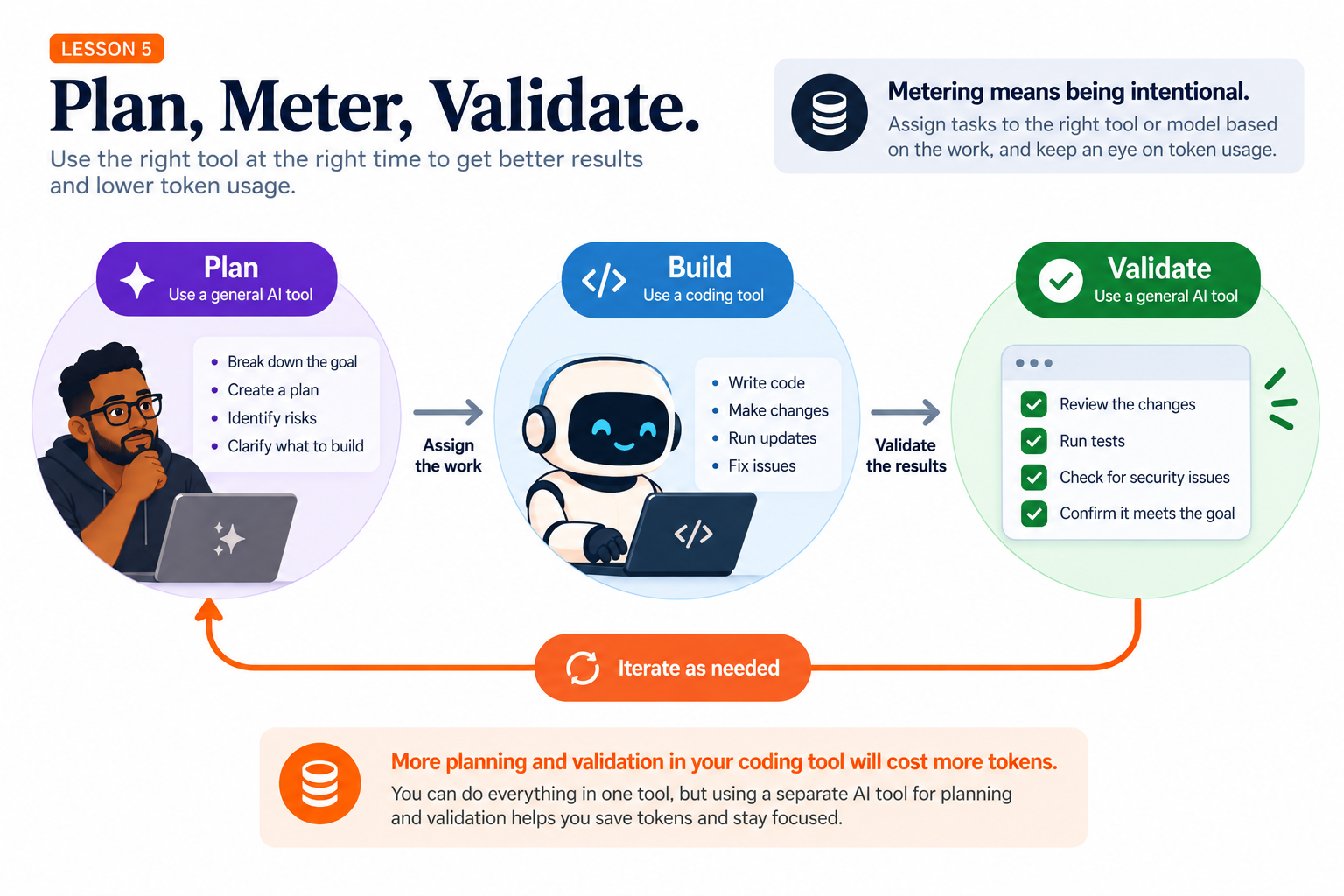
Meter your work
Metering means assigning work deliberately to AI tools based on capability, cost, and usage limits, then monitoring what you consume. Plan and help review with a general AI assistant; use a coding tool for building and modifying code.
You can plan inside a coding tool, too, but that may consume more of its coding-agent allowance. Compare actual pricing and limits rather than assuming a particular setup is cheaper. Tests and AI reviews support your decision; they do not replace human validation.
Token-maxing: make your allowance go further
Token-maxing means doing what you reasonably can to stretch a limited AI coding allowance. If you have one paid subscription at roughly $20 a month, an open-ended coding request can consume a surprising amount of your available usage.
Try opening ChatGPT in your web browser first. Use that conversation to define the goal, scope, acceptance criteria, and exact instructions. Then copy the finished implementation prompt into your coding app and let it work. This can reduce exploratory back-and-forth inside the coding tool, although usage accounting and limits vary by product and plan.
Example: give the coder boundaries
Instead of saying “Improve my vendor risk scorer,” plan the change in the browser and paste a focused assignment into your coding tool:
Add a CSV export for the existing vendor risk summary. Use the current scoring rules and UI patterns. Include tests for empty and missing answers. Do not change the scoring algorithm, install dependencies, redesign the interface, alter unrelated files, or merge the PR. If anything requires a change outside this scope, stop and ask first.
That final sentence matters. It tells the agent what not to take liberties with, so you spend fewer iterations undoing unnecessary changes. Review the diff and tests before approving.
Metering is how you assign and monitor work across tools. Token-maxing is the broader habit of getting useful results from your available allowance through planning, tight scope, and fewer wasted iterations.
The GRC connection
Efficiency includes governance: usage costs, approved tools, information handling, and review quality all matter.
Put it into practice
Compare two ways to implement a small CSV export: an open-ended coding request versus a scoped blueprint. Record iterations, time, usage where visible, review quality, and data-handling concerns.
What good looks like
You compare two usage approaches and explain their cost, scope, data handling, and review tradeoffs.
Check the result yourself. Save the decision or next step in GitHub so you can return to it later.